
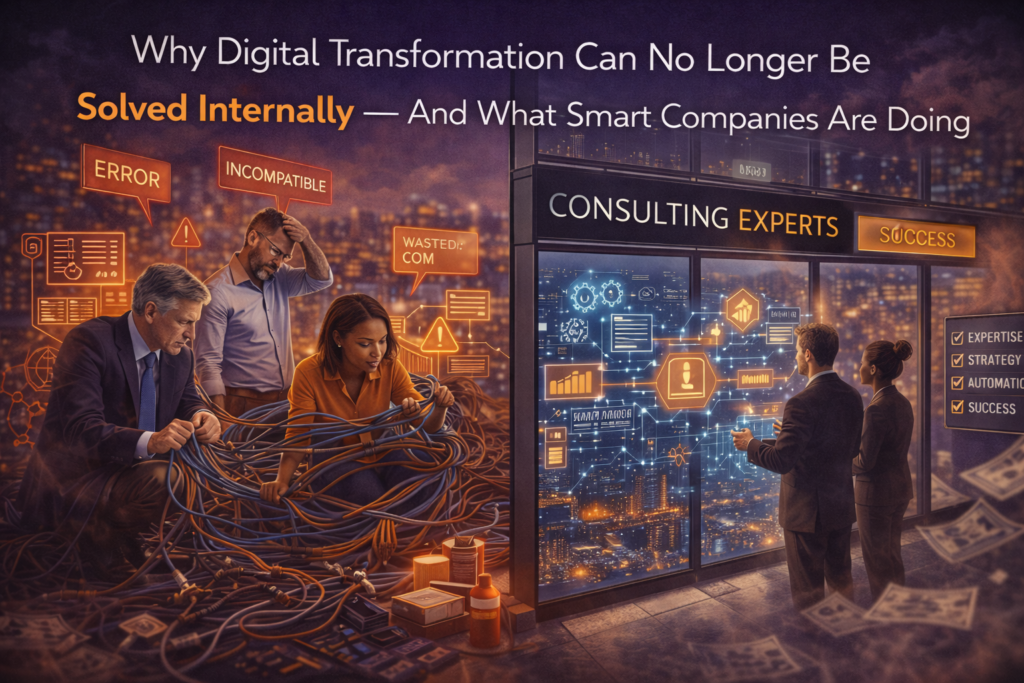
As the complexity of digital transformation outgrows the internal capabilities of most organizations, those attempting to transform in isolation face significant risks, including limited perspective and sluggish execution. True progress now depends on ecosystem participation, which allows companies to leverage external platforms, networks, and collaborations to accelerate learning and reduce costly mistakes. Exposure to real-world industry implementations has become critical for effective system design and AI adoption, as these external insights provide the blueprints for higher execution quality. Ultimately, the landscape has shifted: leading organizations no longer view transformation as an internally contained project, but as an ecosystem-driven journey where collaboration serves as a vital engine for staying ahead of the competition.
Introduction: The Limits of Internal Thinking
Most companies approach digital transformation like this:
- Analyse internally
- Plan internally
- Execute internally
It feels controlled.
It feels safe.
But in today’s environment:
👉 it is no longer enough
Because transformation today involves:
- AI
- automation
- system integration
- workflow design
- data architecture
👉 And no single organisation has full visibility across all of these
The Current Problem: Trying to Solve Complex Problems in Isolation
Many businesses still rely on:
- internal discussions
- limited vendor input
- past experience
This creates three major limitations:
1. Narrow Perspective
Decisions are based on:
👉 internal assumptions
2. Repeated Mistakes
Companies:
👉 reinvent solutions
👉 repeat industry errors
3. Slower Progress
Learning happens:
👉 through trial and error
👉 The result:
👉 transformation becomes slower, riskier, and less effective
The Strategic Framework: The 5 Advantages of Ecosystem Thinking
Smart organisations are shifting their approach.
From:
👉 Internal-only
To:
👉 Ecosystem-driven
1. Exposure to Real Implementations
Instead of guessing:
👉 companies see how others execute
- real workflows
- real systems
- real outcomes
👉 This accelerates understanding
2. Faster Learning Curve
Ecosystems allow companies to:
- learn from others’ experiences
- avoid common mistakes
- adopt proven strategies
👉 This reduces trial-and-error cost
3. Better Decision-Making
With broader insight:
👉 decisions become more informed
Leaders can:
- compare approaches
- evaluate trade-offs
- choose more effectively
4. Access to Multiple Expertise
Instead of relying on:
👉 one vendor
Companies gain access to:
- multiple specialists
- different perspectives
- cross-industry knowledge
👉 This improves solution quality
5. Opportunity Creation
Ecosystems create:
- partnerships
- collaborations
- business opportunities
👉 Growth becomes faster and more strategic
Deep Breakdown: Why Isolation Is Now a Risk
The Complexity Problem
Digital transformation today is:
👉 multi-layered
- systems
- workflows
- AI
- data
- people
Trying to solve all internally:
👉 creates blind spots
The Speed Problem
Markets are moving fast.
Companies that rely only on internal learning:
👉 move slower
While others:
👉 learn from the ecosystem and accelerate
The Visibility Problem
Many companies:
👉 don’t know what they don’t know
Without exposure:
👉 they miss better approaches
Business Implications
For SMEs
SMEs cannot afford:
- long learning cycles
- repeated mistakes
Ecosystem exposure allows them to:
👉 shortcut learning
For Growing Companies
As complexity increases:
👉 internal limitations become more visible
Ecosystem thinking provides:
👉 clarity and direction
For Corporate Decision-Makers
Corporates are shifting toward:
👉 ecosystem-based transformation
Because:
👉 no single team can cover everything
Ecosystem Layer
This is where the market is evolving.
Transformation is no longer:
👉 an internal project
It is:
👉 a connected journey
Leading companies are:
- engaging with industry platforms
- observing real implementations
- connecting with solution providers
- learning from peers
Because:
👉 exposure reduces risk
👉 connection accelerates growth
👉 positioning creates opportunity
FAQ
1. What is an ecosystem in digital transformation?
A network of companies, experts, and platforms that share knowledge, solutions, and opportunities.
2. Why can’t companies do transformation internally?
Because the complexity exceeds internal knowledge and visibility.
3. Does this replace internal teams?
No. It enhances decision-making and execution capability.
4. Is ecosystem participation only for large companies?
No. SMEs benefit even more due to faster learning.
5. What is the biggest risk of staying isolated?
Slow progress, repeated mistakes, and missed opportunities.
Conclusion
The biggest shift in digital transformation is not technology.
It is:
👉 how companies learn and evolve
Because today:
- knowledge is distributed
- experience is shared
- innovation is collaborative
And the companies that move ahead are not:
👉 the ones who try to solve everything alone
But:
👉 the ones who position themselves in the right ecosystem
Because in this new environment:
👉 isolation slows you down
👉 connection moves you forward
So the real question is:
👉 Are you trying to solve transformation alone… or positioning yourself where growth actually happens?